
Updated: January, 2026
This guide reflects what teaching kindergarten in China looks like in 2026, based on nearly a decade of experience working in the sector.
Having the chance to sit back and reflect on my experience teaching kindergarten in China feels strangely therapeutic. I spent most of my time in China working in kindergartens, and I can honestly say I loved almost every minute of it.
Teaching young children is not for everyone. It requires patience, emotional energy, and a genuine interest in children. I grew up in a large Irish family surrounded by younger relatives, which helped enormously. When I walked into my first classroom in China, I didn’t feel out of place. Working with children felt natural, and I quickly realised I genuinely enjoyed it. This felt even more relevant when I had my own children.
If you recognise some of that in yourself, teaching kindergarten in China might suit you more than you expect.
In this article, I will walk through what the job actually looks like in 2026. The different types of kindergartens, what a typical week involves, what is expected of teachers, what you can earn, and the traits that genuinely matter if you want to enjoy the work long term.
And yes, if you are cut out for it, you will have an absolute ball!
Here’s what I’ll cover in this guide – click through the links to get to your desired topic:
TABLE OF CONTENTS
Kindergartens in China – how they differ
International kindergartens VS regular kindergartens
Chinese kindergartens VS western kindergartens
What my regular teaching week in China looks like
What does a kindergarten teacher in China usually do?
What I love most about teaching kindergarten in China
Requirements to teach Kindergarten in China
What traits should I have to be a kindergarten teacher?
What kind of salary can I earn as a kindergarten teacher in China?
Kindergartens in China – how they differ
As with all school types in China, there is no single “kindergarten experience” in China. The differences between schools are significant and matter more than many teachers realise before arriving.
At the top end are kindergartens attached to international schools. These are extremely well resourced, expensive for parents, and selective in who they hire. Pay and benefits tend to be strong.
Bilingual kindergartens occupy the middle ground. They combine elements of Chinese and international education, often with high expectations placed on foreign teachers. Many are commercially driven and highly competitive.
Local private kindergartens are the most common. These usually follow the Chinese curriculum with English added as a subject. Class sizes are often larger and the structure more rigid.
Understanding which environment you are entering matters just as much as the salary.
International kindergartens usually follow an international curriculum and calendar, which means proper Christmas and summer holidays alongside Chinese public holidays. To work in one, you typically need some experience, but not always a full teaching licence. It often comes down to what that school needs at the time.
Class sizes are generally smaller, which makes the job more enjoyable and allows you to support each child properly. These schools absolutely still exist, but the market has shifted. Some are now competing harder for enrolments and, in some cases, have added more teaching days to the calendar. If you land a role that still gives you four to six weeks off in summer, you’ve done very well.
Bilingual kindergartens follow the local Chinese holiday calendar, which means noticeably less time off. Unlike international teachers, you only receive public holidays plus annual leave. This is now what most standard kindergarten jobs in China look like.
Annual leave varies widely, but in 2026 the common baseline is around four weeks outside of public holidays. Some schools offer less, a few offer slightly more, so it’s something you should always clarify before signing.
Kindergarten salaries can still be strong, but there is a trade-off. The holidays are shorter and the daily contact time with children is high, which can be physically and emotionally demanding.
There are also local, government-licensed private kindergartens, similar to small neighbourhood kindergartens back home. These follow the Chinese curriculum, have large classes, often up to 30 children, and usually have little or no English. These schools generally do not hire foreign teachers, and many are not permitted to do so.
Requirements and pay can vary wildly between kindergartens but, by and large, however, these are still among the most lucrative teaching jobs in China.
Chinese versus Western approaches
If you are expecting Chinese kindergartens to look anything like their Western equivalents, you may be in for a few surprises.
For a start, most kindergartens in China are full-day programs. Children usually arrive around 8.30am and often stay until 4.30 or 5pm. Some schools provide breakfast, some do not, but either way the days are long for both students and teachers.
A typical teaching contract still works out at around a 40-hour week.
The good news is that the day is usually broken up by a lunch and nap period. How generous this break is depends entirely on the school. Some offer two hours or more, others only one. If you are unlucky, that hour might be spent supervising children while they sleep. That said, there is usually a Chinese co-teacher present, and in most cases they handle the bulk of the supervision while you quietly prep or recover in the corner.
Philosophically, Chinese kindergartens are also quite different. In the West, early years education is usually play-based, with a strong focus on holistic development. China is slowly moving in that direction, and you will hear a lot more talk about child-led learning and frameworks such as EYFS than you would have ten years ago.
In practice, though, there is still a strong academic emphasis, which is very much rooted in Confucian culture. You often see a relatively relaxed approach with younger children aged three to five. That changes noticeably with the oldest group, aged five to six, when schools begin preparing students for primary school. At this stage, it is common to see formal reading and writing classes, intensive Chinese character work, and structured maths lessons. Many of these children are working at levels that would surprise teachers in native English-speaking countries.
Days are busy. A typical timetable includes language classes, maths, art, music, physical activity, and general knowledge. On top of that, many children attend extracurricular classes after the school day ends. These might be dance, art, extra English, or other activities. They are usually run by outside providers rather than the school itself, and you are not normally expected to teach them. Still, it is something worth checking in your contract, and if you are asked to take part, make sure it is paid.
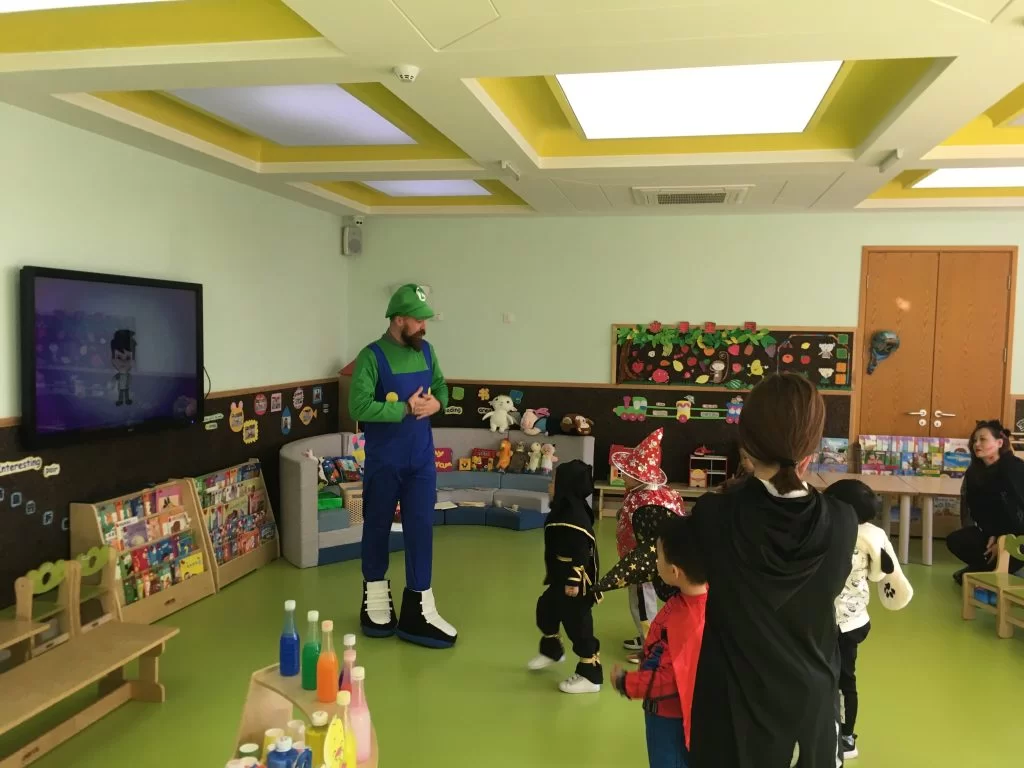
What a real teaching week looks like
A typical day usually involved a mix of teaching formats. You might teach two larger classes of around 30 minutes each, or one big class alongside several small group sessions. Small groups are often just two to four students, much more relaxed, and far less draining than full classes. On some days, you may be scheduled for both. This is why it is important to understand your timetable before you start.
Workloads can vary widely between schools, and you need to know whether what is being offered is actually sustainable for you.
Beyond English classes, you will usually be involved in supervising other activities such as sports, cooking, or general classroom routines. You also spend time watching children during playtime to make sure they are safe. In reality, much of the job is care-based rather than purely academic teaching. The days can be long, but the work itself is not usually intense.
Before I moved into a principal role, I worked as an ESL teacher at a high-end kindergarten in Beijing. My focus was teaching the basics of English through repetition, daily routines, and topics the children actually cared about. I constantly encouraged them to use English outside the classroom too. After a few months, the progress was obvious, and it was incredibly rewarding to watch. Phonics was also a major part of my approach.
When I started, I had no real idea how to teach young learners. I learned on the job, with help from friends, a very patient partner, and a lot of YouTube. It worked for me, eventually.
But I would not recommend that route if you are new to teaching. You are far better off joining a kindergarten with multiple foreign teachers and, ideally, a strong foreign lead who knows how to teach young learners properly. Learning from experienced colleagues will save you a ton of frustration and help you develop faster than trying to figure everything out on your own.
What does a kindergarten teacher in China usually do?
Teaching is only part of the role.
You attend a lot of meetings. Many will be in Chinese. Sometimes, you don’t even know why you are there but that is all part of working life in China.
You are also often expected to support marketing activities. Foreign teachers are seen as a selling point, and schools sometimes involve you in open days, promotional videos, and parent events.
If you are a homeroom teacher, communication with parents can be frequent. Parents are highly invested in their children’s progress and expectations on you can be high.
Paperwork is obviously also part of the job: reports, lesson plans, observations, and documentation are common. Bureaucracy is simply part of the system.
As a foreign teacher, you will also be asked to dress up and participate in classroom activities. I particularly loved dressing up as Santa, the Easter Bunny and wearing Halloween costumes at work. Not everyone will enjoy this part of the job, but it was a blast and a highlight for me!
What I enjoyed most
It sounds obvious, but it really is the children.
Kindergarten teachers have the chance to shape the very foundations of a child’s learning. Over the year, you watch students grow not just physically but emotionally and academically too. Children who start with just a handful of English words begin to understand you, respond to you, and eventually hold simple conversations. Seeing that progress unfold in real time is deeply rewarding.
If you are lucky enough to have a decent lunch break or prep time, it also makes a real difference to your day. A two-hour break can turn a long schedule into something far more manageable and gives you space to reset. I used that time to work on side projects, including slowly setting up China By Teaching (and unsuccessfully trying to learn Chinese).
The type of kindergarten you work in will largely determine your work-life balance. International schools tend to offer generous summer and winter holidays. Smaller or less established schools often offer far less time off, usually limited to public holidays and some annual leave.

Requirements to Teach Kindergarten in China
Most schools require:
- A bachelor’s degree in any subject
- A clean criminal background check
- A 120-hour TEFL certificate unless you hold an Education or Early Years degree
- Some teaching experience preferred
- Age requirements that vary by province and school
Experience with children helps, but personality and attitude matter just as much.
Traits to be a Kindergarten Teacher
When I started teaching, I only had a basic understanding of how to teach young learners. What I did have was enthusiasm, patience, and a genuine enjoyment of being around children. Those qualities cannot be taught in a course.
Over nearly eight years in China, I worked with some outstanding kindergarten teachers. Some were highly qualified, others were not, yet many would thrive in any international school setting. I also saw the opposite: teachers who had little interest in children and were there purely for the paycheck. That mindset almost always leads to burnout. Kindergarten days are long, holidays can be limited, and the emotional energy required is real. If you do not genuinely enjoy working with young children, the job will wear you down quickly.
The traits that matter most are simple, but non-negotiable:
- Passion
• Patience
• Empathy
• Creativity
• A genuine desire to be a positive role model
You do not need to be a perfect teacher. But you do need to care. Children notice quickly who is present, who is engaged, and who is only going through the motions. They are also expected to learn while in your care, not just sing songs and pass the time, which is one of the reasons kindergarten roles in China are taken seriously and paid accordingly.
The Salary I Can Earn as a Kindergarten Teacher in China
- Tier 1 Cities: 20,000 – 26,000 RMB per month (After Tax)
- Tier 2 Cities: 18,000 – 22,000 RMB per month (After Tax)
- Tier 3 Cities: 14,000 – 20,000 RMB per month (After Tax)
Salaries peaked during COVID, when some teachers were earning 35,000 RMB or more after tax. That period is over: borders reopened, supply increased, and schools became more cost-conscious. Many kindergartens also closed during that period, which further tightened the market.
That said, teaching kindergarten in China remains one of the better-paid ESL options globally when benefits are factored in. Housing, flights, insurance, bonuses, and low living costs in many cities still make it possible to save consistently.
The real difference between offers is often not the salary itself but the package and workload.
Despite the frustrations, the bureaucracy, the long days, and the occasional chaos, teaching kindergarten in China remains one of the most meaningful experiences of my life.
If you think you have what it takes to be a kindergarten teacher in China and would love to know what kind of opportunities are out there, simply send us your CV and we’ll be in touch.
More fun reading:
